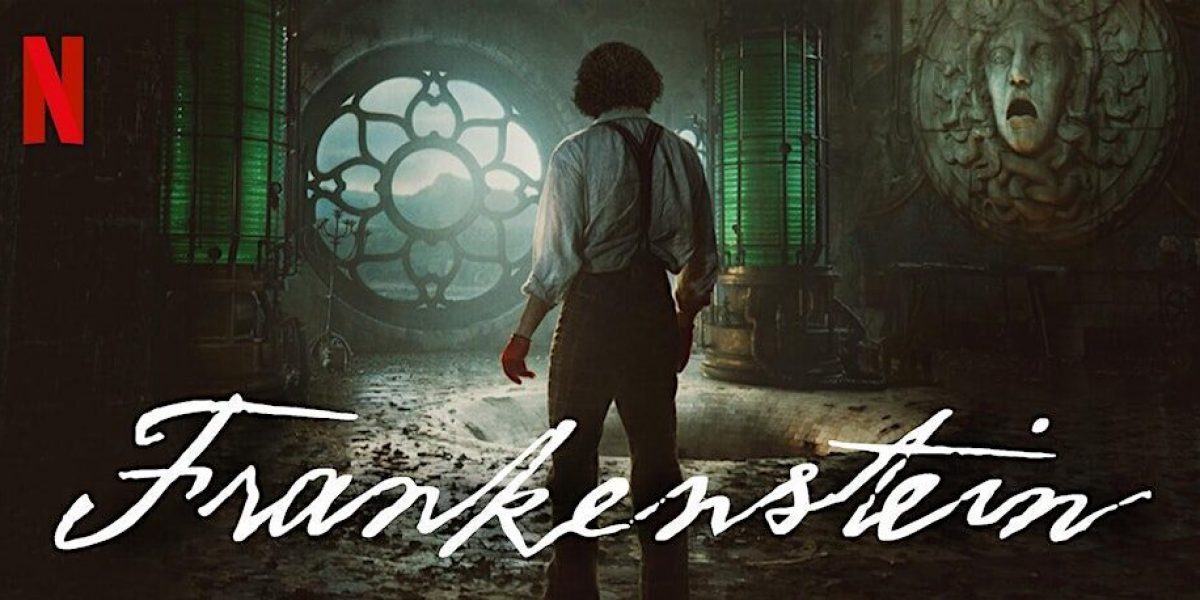

Guillermo del Toro’s sumptuous Frankenstein (finally) hits the screens, but was it worth the wait?
A lot of directors have pet projects they’ve been quietly nurturing for years, but when they eventually bring them to the big screen, the results are overcooked and unconvincing.
A lot of directors aren’t Guillermo del Toro.
The Mexican director has told anyone who’d listen for decades now about how Frank Darabont’s script was perfect, but the Branagh production that eventually evolved from it…not so much. del Toro felt that given the opportunity, he could somehow stitch that script together with Bernie Wrightson’s legendary creature designs and his own visual imagination and film making talents, then blast a few million volts (dollars, whatever) of Netflix’s cash through it to create something wonderful. Turns out he was right.
Guillermo del Toro’s Frankenstein feels like the film that so much of his work was leading up to. The film expands the meticulous period detail (and dastardly shenanigans in remote forsaken towers) of the underrated Crimson Peak. It also classically embodies the themes of misunderstood but caring monsters and despotic, gloweringly obsessive men that have shown up in perhaps the majority of del Toro’s films, from The Shape of Water and The Devil’s Backbone to his brace of Hellboy films.
The production design for this film is unsurprisingly ravishing, a painterly eye for detail applied to everything from lab technology to corpse-littered battlefields (the frozen horse is especially spectacular), and feels like it leans more towards the artists of the era, especially Blake and the pre-Raphaelites, than to previous productions. My only reservation concerns some occasionally unconvincing CG, which doesn’t ruin anything, but jars a little in GDT’s otherwise meticulous worldbuilding.
The costumes are also beautifully designed and striking but not distractingly so, apart from Mia Goth(ic horror) as Victor’s mother’s in a dramatic red net number and his father, played cadaverously by Charles Dance in a distinctively silhouetted military uniform. Beyond that, it’s mostly Elizabeth (Goth again) in a variety of big Victorian frocks. All of these and a ton of props and set photos can be seen until 9 November at the Frankenstein exhibition in the old hotel behind Selfridges, as can a lot of the make-ups. This did worry me initially, as in the pallid flesh the creature’s prosthetics look more Corpse Bride than Modern Prometheus. Thankfully in the actual film, the camera and Jacob Elordi’s performance quickly dispel any worries, and he looks completely the part.
Elordi’s performance is a stand-out in the film, one of few words but great physical expression. The role feels made for the tall but graceful actor (impressive as he was a late addition, replacing Andrew Garfield), and gives him the opportunity to be by turns childlike, fragile, balletic and terrifyingly violent and physical – for a 15-certificate, Frankenstein is properly brutal in places, in true del Toro style.
Elsewhere, Mia Goth continues to cement her place as a horror icon, with a performance that gives the character more agency than her usual fate as an elegantly dressed prize, and allows her to not be entirely sympathetic, though she’s slightly underused. Christoph Waltz, meanwhile, is more subdued than usual, though even at half-glow, he’s great, while Dance is rottingly sneering, and David Bradley plays a rare sympathetic role.
The film belongs to Oscar Isaac though, his performance as Victor Frankenstein a sweating, twitching, tantruming ball of toxic energy, cannonballing through money, lives and society in pursuit of his obsession. I’d previously mostly only seen him running around with swords and pop guns in action franchises. He makes good use of that physicality here, but adds a deep and loathsome mania and ruthlessness. It’s amazing how unrepentingly vile his portrayal of Victor is. Most productions give the character at least a glimmer of sympathy and humanity, but Isaac’s Victor is a user and manipulator, taking advantage of his patron’s money, his brother’s trust (played as a sunny antidote to Victor by Felix Kammerer), and attempting to take advantage of Elizabeth’s body. He makes the film a compelling rise and fall of a man who richly deserves his fate, but takes many others with him.
It would be impossible to call Guillermo del Toro’s Frankenstein a daringly radical or boundary-smashing take on the age-old tale, and it won’t reinvent how we look at the character, or the horror medium. There are changes from the original story, and they make sense, but they feel in sympathy with the original story. There are also call-backs to several other productions, intended or otherwise, without mimicking any of them.
Mostly, however, this feels like del Toro trying to build his lifelong obsession as well as he can possibly make it, and then breathe life into it. In this he succeeds handsomely, and while just occasionally you can see the stitching, you can also see the passion, the art and the understanding of the true meaning of Frankenstein that went into it.
Frankenstein premieres on Netflix on 7th November, but do yourself a favour and catch it on the big screen during its limited run if you have the chance.
Bernie Wrightson’s Frankenstein graphic novel is still available from Simon & Schuster, and is also fantastic.