
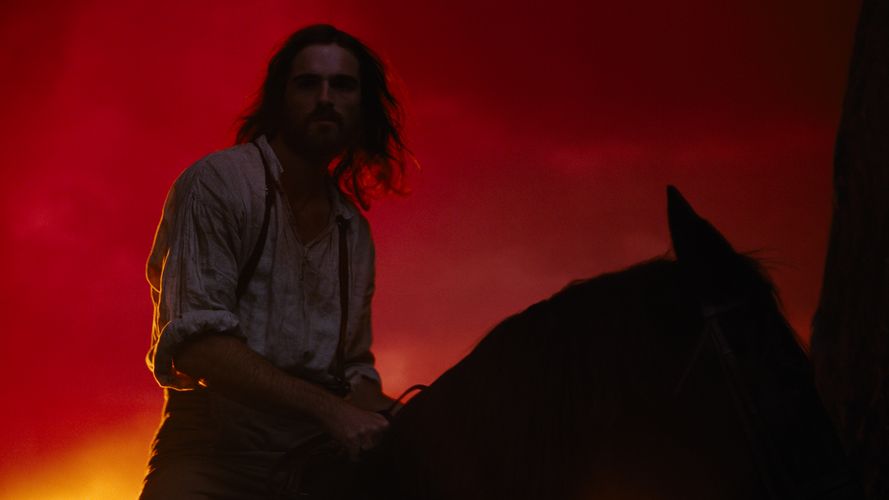
Margot and Jacob hit the heights in Emerald Fennel’s squelchily thirsty adaptation
It must be frustrating for Emerald Fennel to have spent so much time telling everyone who’d listen that her new film would be Wuthering Heights, but as she experienced reading it at the age of 14, and then be subject to an avalanche of sniffy reviews grumbling that it’s too basic, too sexy, too lurid… y’know, like a teenager made it. She even put the title in inverted commas to hammer it home that this is a very loose adaptation.
The film got pilloried too for not sticking to the book, which is absurd, as none of the adaptations I’m aware of have done. All of them chop off a substantial part of the book, just before Kate Bush gets going.
So, does “Wuthering Heights” (this is the one and only time I’ll use those quote marks, FYI) deserve all the po-faced finger-pointing?
Not at all. It’s a gloriously camp, theatrical and overexcited melodrama that does exactly what it sets out to do. It’s the perfect film for anyone who’s read one of those literary classics full of unreleased sexual tension and metaphor, and thought “Just fuck already!”
And do they fuck? Oh yes.
In gardens, on soggy moors, in coaches, in barns, as if making up for nearly 200 years of corseted yearning. And yes, bodices are quite literally ripped. While the main participants are obviously Jacob Elordi (who should probably change his middle name to ‘dreamy’) and Margot Robbie, who looks as gloriously un-period as the film, around them others are at it too, including a couple of kinky servants who somehow got hold of a very, very early proof of 50 Shades.
Oddly enough the actual sex scenes, which have been criticised as ‘too graphic’ by a lot of reviewers, aren’t especially explicit and leave most things to the imagination (which says a lot about those reviewers’ imaginations). Conversely a lot of the most sexualised and sensual filming is in the little insert (not that sort) shots Fennel adds throughout – snails juicily sliding up a window in super close-up, someone elbow-deep in slippery pig guts. The director lingers on these in great, Greenaway-esque detail, and for such a damp and windswept film, it’s rather overheated for most of its running time.
The performances are definitely extra, but also excellent. Robbie’s Cathy is passionate, capricious and smart, knowingly self-destructive but unable to stop herself. Elordi is the consummate towering force of nature, raised as a brute and no less of a brute after he went away and found money and a good tailor. Meanwhile Martin Clunes unleashes his best Dickensian ham as Cathy’s vile, drunk and rotting but complicated father, who can’t see an urchin left out on the street, but is also a bullying and neglectful guardian, and Hong Chau’s Nelly quietly controls the entire narrative. There’s also Alison Oliver’s memorable performance as Arabella. I don’t recall the character from the book, but in the film she’s a repressed volcano of nerdy rage and lust.
Wuthering Heights looks absolutely incredible too. There’s nothing remotely period about any of it – from Cathy’s outfits, which combine latex, clear plastic, stretch fabrics and other modern affectations into huge fetishistically Victorian creations, to the obsidian monolith that is her childhood home. And then there’s her marital home – a super-heightened chocolate box of colourful flowers and ornamental fishbowls on the outside, a Spandau Ballet video fever dream on the inside. White plaster hands rise from the fireplace or hold sconces, while paisley wallpaper patterns leak from the walls across all surfaces, and Cathy’s own room is painted to look like her skin in detail, veins and freckles included at giant scale.
The latter feels very Cronenberg, but you can also see the influence of Coppola’s Dracula in this piece, though here the vampires are mostly symbolic, as well as Tarsem Singh’s monumentally bold set designs. More than anything though, the combination of overheated melodrama, crimson lubriciousness and ostentatiously simple 80s-style set designs reminds me of nothing more than Ken Russell. We’d rewatched Gothic only the night before seeing Wuthering Heights, and the similarities were obvious.
I haven’t read Wuthering Heights for years, so I can’t say how accurate it is, but then that was never the point. However what stands out is that through taking an accessible and relatable approach, or through casting the towering thirst trap that is Jacob Elordi and the fantastic Margot Robbie, Emerald Fennel managed to entirely sell out the crappy retail park multiplex we were in on a rainy Sunday afternoon, which is considerably more than the last four franchise ‘blockbusters’ we saw there.
Being able to do that with an adaptation of a book that came out 180 years ago is an impressive feat, however she got there.



Leave a Reply